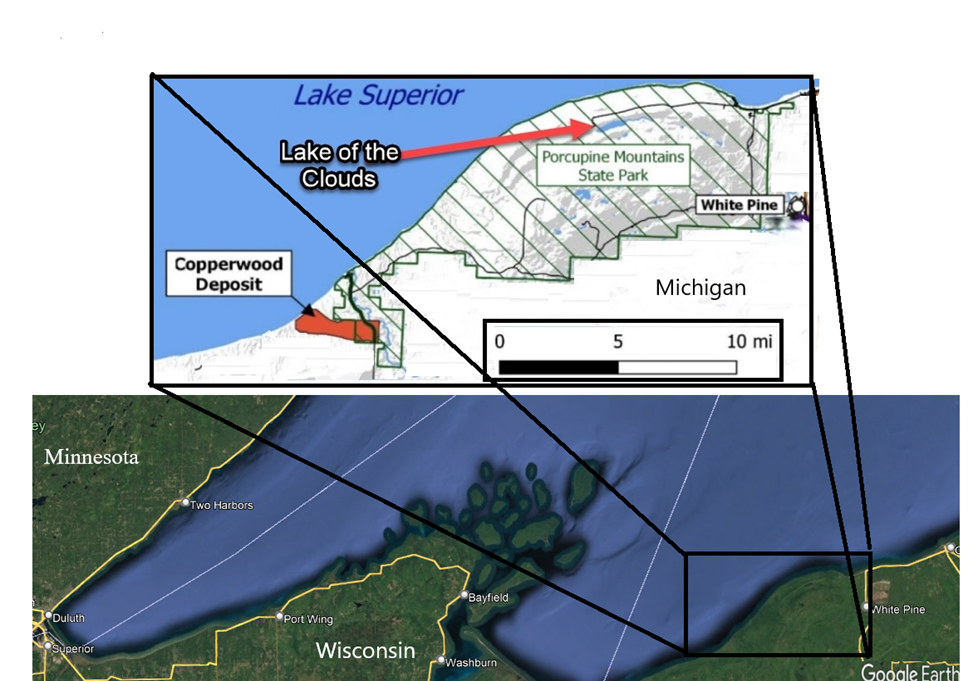
Location of the Copperwood project next to the Porcupine Mountains State Park (the formal name is the Porcupine Mountains Wilderness Area State Park) and Lake of the Clouds. (Courtesy of Google Earth with locations of Cooperwood Deposit, Lake of the Clouds, and White Pine added by author)
Location, location, location is the issue with Michigan’s Copperwood Mine project. Environmentalists worry about a sulfide mineral mining’s potential for the creation of acid water and the release of metals to the environment in the area contiguous with sulfide mineral mining and milling sites. Conservationist who oppose the Copperwood Mine want no development of any type in any of the thousands of acres adjacent to the Porcupine Mountain wilderness area (the Porkies). Native Americans want to preserve their ability to hunt and gather on their Porcupine Mountain ancestral lands.
The Copperwood Mine project is perched on high ground three miles from Lake Superior on the southwestern edge of Michigan’s 60,000-acre Porcupine Mountains Wilderness State Park (PMWA). Support for the Porkies wilderness area located in Michigan’s Gogebic and Ontonagon Counties goes back to the early 1940s when local citizens started the movement to create the park. In 1942, Aldo Leopold, pioneer in environmental ethics, wrote “The Last Stand” for the magazine Outdoor America. This essay is a passionate plea to save the old growth northern hardwoods — the Great Uncut— in the Porcupine Mountains.
Leopold said, “…the green robe of the Porcupines has shrunk to the dimensions of a barely recognizable necktie… But the Porcupine necktie is more than timber; it is a symbol. It portrays a chapter in national history which we should not be allowed to forget. When we abolish the last sample of the Great Uncut, we are, in a sense, burning books. …I would like to see the Porcupine region acquired and preserved as an act of national contrition, as the visible reminder of an unsolved problem, as a token of thing hoped for. To this end it had best be kept roadless, axeless, hotel-less, and open only to ski or foot travel.”
The campaign to save the Porcupine Mountain wilderness area culminated in 1945 thanks to the support of the governor and the director of the Michigan Department of Conservation when the State spent $1 million to purchase the approximately 60,000 acres that became PMWA. Today the area is home to moose, grey wolves, white-tailed deer, coyotes, gray/red foxes, cougar, river otters, beaver, fisher, marten, mink, bobcat, lynx, black bears, porcupines, and a wide range of birds.
Protect the Porkies
In June of 2023 a new organization, Protect the Porkies (PTP), launched a petition drive advocating that the Copperwood Mine project be canceled. Protect the Porkies says “they are a collective of concerned citizens from around the Upper Peninsula, the great state of Michigan, and beyond, who are uniting to resist the development of Copperwood, an inexperienced Canadian company’s proposal to mine next to and underneath Porcupine Mountains Wilderness State Park and store 40+ million tons of waste in unprecedented proximity to Lake Superior, all for the sake of a few boom-and-bust jobs and copper to be shipped out of country.”
In my August 2024 interview, Tom Grotewohl, the leader of the PTP organization, emphasized that PTP does not want new roads, new power lines, or any signs of development at the location of the Copperwood Mine. He said the PTP it not just opposed to the Copperwood project because it is a mine – they want no development done in the Porkies and they would oppose the building of a Walmart for the same reason they oppose the roads, power lines, light pollution, and noise that will come with the Copperwood project. Grotewohl’s views to keep any development away from the Porkies seems to me to be equivalent to what conservationist Aldo Leopold said in 1942 about preserving the Great Uncut of the Porkies.
Negative design elements of the Copperwood Mine
Consideration of the elements of the Copperwood Mine project is an excellent example that individual sulfide mines have very different characteristics. The operating Eagle Mine and several of the proposed sulfide mineral mines in the Northern Midwest have mitigating features for the handling of mining waste (tailings) that the Copperwood Mine plan does not share.
Unlike the operating Eagle Mine and the proposed Tamarack Mine where no onsite milling of ore and storing of mining waste (tailings) is done or is planned to be done at the mine site, the Copperwood Mine plans to do milling at the site. Milling sulfide ore involves grinding the ore down to fine sand /silt size to produce a concentrate with a high metallic content. The sulfide ore at Copperwood contains less than 2% copper so the milling operation results in the production of tons of waste (tailings). A Feasibility Study Update for the Copperwood Project dated April 20, 2023 said the onsite tailings disposal facility (TDF) from the Copperwood Mine’s mill will occupy 320 acres (6,562 feet by 2,559 feet).
The tailings facility planned for the Copperwood Mine lacks several features of other sulfide mines. The Humboldt Mill tailings disposal facility for the Eagle Mine is in a lake formed by an open pit mine dug into largely impermeable rock located on a straight line 20 plus miles from the Eagle Mine site. The plan for Minnesota’s Tamarack Mine is to transport the tailings in covered rail cars to North Dakota where the tailings will be entombed in cement-like slabs. The storage basin planned for the Copperwood Mine’s tailings will be situated on unconsolidated sand and soil next to the Copperwood Mine so that the Copperwood project location will have the dual risk of both mine and mill.
The enormous size of Copperwood’s TDF reported in the 2023 study may be somewhat reduced according to the completion of a “Phase 1” detailed engineering study. This Phase I study announced in October 2025 indicated that thickened tailings could be stored underground, which would reduce the footprint of the TDF by approximately 40%. This 2025 finding directly contradicts a study completed by Golder and Associates in 2012 that found that underground storage of tailings for the Copperwood Mine would be neither feasible nor prudent.
Native American Concerns
Thousands of years before twenty-first century conservationists and environmentalists became concerned about the wilderness area of the Porkies, Native Americans were present in the area. Most research says that the Porcupine Mountains were named by the Indigenous Ojibwe (Chippewa) people, who called them Kag-wadjiw (Porcupine Mountain). The name originated from the mountains’ distinct silhouette, as their undulating ridgelines and forest cover resemble a giant, crouching porcupine
The Copperwood Project is located within the area covered by the October 4, 1842 Treaty of LaPointe. Although the 1842 treaty provided for Native Americans to cede their rights to the land, they retained rights to use the land to hunt, fish, trap, and gather in the area. Based on their wish to preserve wild lands to hunt and gather, Native Americans are concerned about what would happen if the dam constructed for Copperwood’s TDF should fail and release a cascade of water, chemicals, and slime crashing down slope on its way to Lake Superior. This dam rupture would foul hundreds of acres where Native Americans have hunting and gathering rights and would have unknown consequences flowing into streams and Lake Superior where Native Americans have fishing rights. (In a future blog I will focus on Native American rights in all of the Northern Midwest and discuss the spiritual connection that Native Americans have to the land).
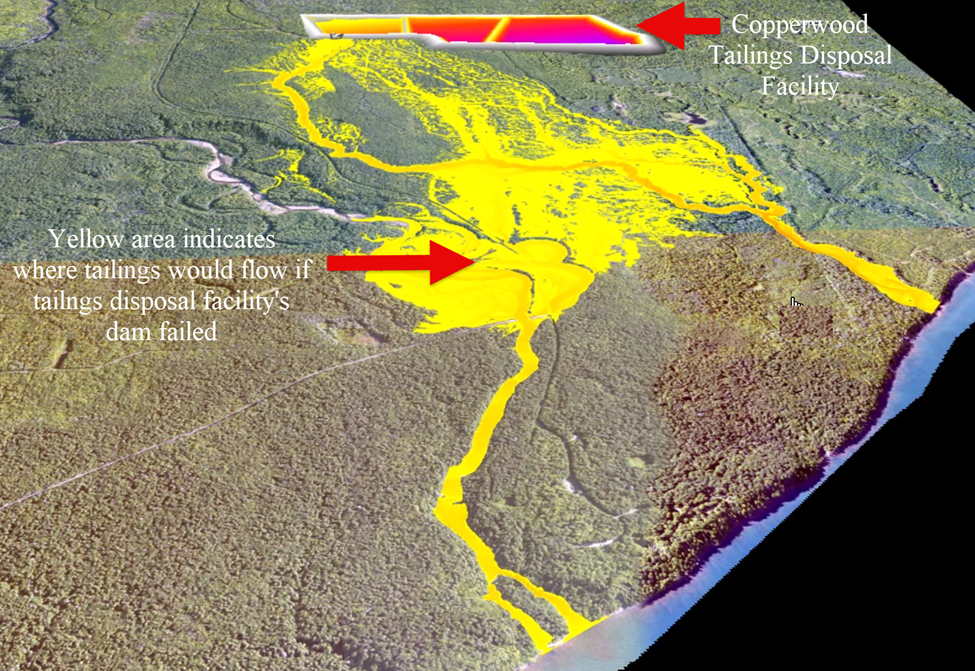
Studies done by Scott Cardiff, John Coleman, and Esteban Chiriboga (Preliminary Dam Breach Inundation Analysis for the Copperwood Project, Administrative Report 24-01, July 2024, Great Lakes Indian Fish & Wildlife Commission) indicate a rupture of the sides of the TDF would place tailings in Lake Superior. Modeling of a failure of the dam on the tailing’s facility estimated that, in the event of a breach, the tailings would reach Lake Superior in less than an hour.

Modeling done on the inundation that would occur with the failure of a dam of the proposed Copperwood tailings facility. The modeling showed extensive areas (shown as yellow) would be covered by tailings. (Courtesy Great Lakes Indian & Wildlife Commission)
Is the construction of the Copperwood Mine “ready to go”?
The Copperwood Mine is a project of Copperwood Resources Inc. (a wholly owned subsidiary of Highland Copper Company Inc.). Highland Copper’s 2026 website viewed on March 11, 2026 said, “The project [Copperwood Mine] has obtained all required permits and is ready to move into construction (pending construction decision and project financing).” Although Highland Copper presents the Copperwood Mine as a ready to go project with all necessary permits, a news release dated January 27, 2026 provided a long list of items in a 2026 work plan. An example of some of these 2026 work items follows with multiple items that could require new permits or major changes to existing permits (bolding added from original).
- Integrated Mine Plan Review: The review will update the Copperwood mine plan to incorporate… potential modifications to the mining method and equipment strategy, and broader market inputs such as copper price movements and relevant cost indices.
- Consideration of Drift and Fill Mining Method: As part of the integrated mine plan review, the applicability of drift and fill mining method will be assessed. This mining method has the potential to increase mine recoveries relative to the room and pillar method considered in the feasibility study.
- Completion of Phase 2 FEED Engineering: Once all design criteria is [sic] finalized, the goal is to advance engineering to approximately 40%, supporting technical due diligence for project financing in 2026. For the tailings’ disposal facility, engineering will be advanced to approximately 80% to provide a higher level of design certainty, cost accuracy, and execution planning.
- Regional Infrastructure Engineering: Highland intends on awarding engineering design packages for key components of regional infrastructure including required road upgrades, installation of site telecommunications, and power source for the operating period.
- Determine Potentially Required Permit Amendments: To the extent any technical optimizations require permit amendments, the project schedule will be adjusted to appropriately reflect timing considerations. Permit amendments may be needed to reflect a revised mining method (if applicable) and the selection of power source to site.
A complete list of the Copperwood Mine 2026 work plan can be found at: https://www.highlandcopper.com/news/highland-copper-recaps-2025-execution-and-announces-2026-work-plan-to-advance-copperwood-toward-construction-decision/
Financial Resources and technical expertise of Highland Copper Company Inc.
One of the most difficult questions to answer about the Copperwood Mine is does the tiny Highland Copper Company Inc. have the financial capability and the technical expertise to construct, operate, and close the mine when mining is done?
Highland’s latest available unaudited financial statement, which is available online states:
For the six months ended December 31, 2025, the Company had negative cash flows from operations of $4,660,170 ($5,691,234 for the six months ended December 31, 2024). In addition, the Company incurred a net loss of $7,014,882 for the six months ended December 31, 2025 and had an accumulated deficit of $71,412,421 as at December 31, 2025 ($64,397,539 as at June 30, 2025). The Company will require additional financing to fund its operations and to meet its planned investment. As at December 31, 2025, the Company had a negative working capital (total current assets less total current liabilities) of $(6,256,353) (positive working capital of $8,864,698 as at June 30, 2025).
The Company’s independent auditor has not performed a review of these unaudited condensed interim consolidated financial statements in accordance with standards established by the Canadian Institute of Chartered Accountants for a review of interim financial statements by an entity’s auditor.
Highland Copper’s financial statements can be found at: https://www.highlandcopper.com/wp-content/uploads/2026/02/HCC-2025-12-31-FS-and-MDA-Merged.pdf
Copperwood Mine has significant political support
Notwithstanding the opposition of PTP and the potential need for the Copperwood project to receive approval for amended permits, the Copperwood Mine has a great deal of political support in the Western Upper Peninsula. Highland Copper posted an online report in February 2026 that reported 22 local government resolutions in support of the Copperwood Mine. Michigan Governor Gretchen Whitmer has expressed support for the Copperwood Mine Project, primarily framing it as a critical economic development opportunity for the Western Upper Peninsula.
Frequently quoted by supporters of the Copperwood Mine is a 2023 report paid for by Highland Resources and published by Public Service Consultants that found that spending for the Copperwood Mine will directly support 300 construction jobs on-site, as well as another 159 jobs at Highland’s vendor partners in the U.P. In addition to these direct jobs, the indirect and induced purchases made by households and businesses as part of this construction spending are expected to support another 353 jobs statewide, many of which are expected to be in the U.P. The investment to bring the Copperwood site online is expected to generate an average of approximately $4.5 million in local, county, and state tax revenue on an annual basis during the three-year construction period.
The 2023 report goes on to say that once the mine is operational, Highland Copper expects to employ 380 workers at Copperwood. In addition to these employees, the mine’s annual operations spending is projected to support another 313 jobs across the state on an annual basis. Operational spending at Copperwood is expected to increase spending to businesses in Michigan by $130 million each year and generate over $12 million in local, county, and state tax revenue on an annual basis.
Analysis of the Copperwood project will be continued in my next blog
Each potential sulfide mineral mine in the Northern Midwest has specific characteristics. The Copperwood Project consists of a tiny company’s efforts to dig a mine with a proposed tailings basin constructed of compacted dirt perched on high ground overlooking Lake Superior. The acidity and toxicity of the tailings created by the Copperwood Mine will be the subject of my next post in my efforts to detail the considerations for the choice that needs to be made between the risks of digging the Copperwood Mine versus the jobs and economic activity that would result from the mine being allowed to be dug.

Next Blog
My next blog will be about the acidity and toxicity of the tailings that could be created by the Copperwood Mine.