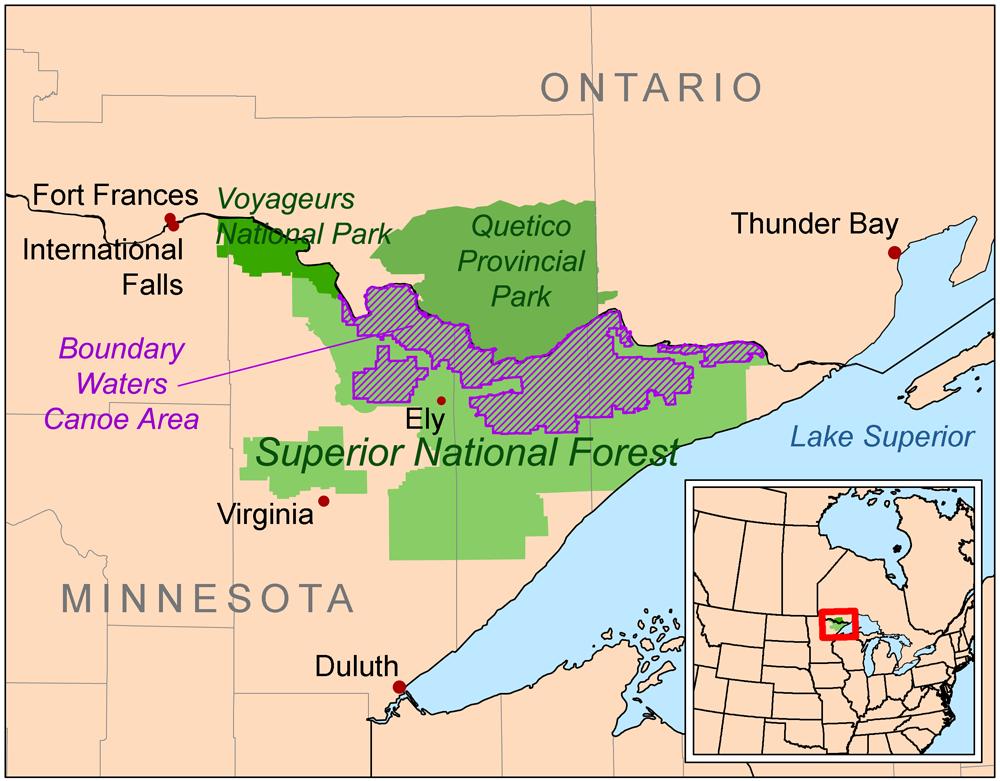
The opinion page in the Wall Street Journal on April 21, 2026 opined the United States Congress had engaged in a liberation act by opening mineral leasing for 225,500 acres of land in the Superior National Forest in northern Minnesota. Congress’s action was done in such a manner that it can’t be undone by a future Democratic President. The editorial also calls for permitting “reform” so mining can commence.
The ability of mining companies to obtain leases for the mineral rights on this land is a prerequisite to mining the copper-nickel sulfide mineral ores that are present in several locations in the Superior National Forest adjacent to the Boundary Waters Canoe Area Wilderness. To date, no company has been able to run the regulatory gauntlet in Minnesota for a permit to mine sulfide mineral ores.
Native Americans have been consistent in opposing sulfide mineral mining wherever it has been proposed in the Northern Midwest (Minnesota, Wisconsin, and Michigan). They will see no “liberation” in allowing sulfide mineral mining.
Unlike the Southeastern United States, where Native Americans were forcefully removed in the 1830s, Native Americans were able to resist removal from the Northern Midwest. Today many Native American Communities endure in Michigan, Wisconsin, and Minnesota in the areas where sulfide mineral deposits are found. In reviewing the jobs and economic benefits that new sulfide mineral mines can bring to the Northern Midwest, I have found that in every case Native Americans have opposed these mines.
Native Americans’ opposition to sulfide mineral mining in Minnesota
In January of 2020, Catherine J. Chavers, President of the Minnesota Chippewa Tribes (MCT), wrote a letter to Minnesota congressmen and women expressing support for legislation that would permanently remove from leasing federal mineral rights that were necessary for the digging of sulfide mineral mines. Her letter pointed out that three MCT Bands —the Grand Portage, the Fond du Lac, and the Bois Forte—retain hunting, fishing, and other usufructuary rights [the type of property right that allows the use of something in the public domain] throughout the entire northeast portion of the State of Minnesota under the 1854 Treaty of LaPointe. Her letter maintained that sulfide ore mining would increase the amount of mercury in fish. Mercury is a toxin of great concern to Tribe members who depend on wild fish for sustenance. Her letter also expressed concerns about the detrimental effects that sulfide mining could have on wild rice and terrestrial species.
To the south of the Superior National Forest legal action initiated by the Fond du Lac Band of Chippewa and others in 2023 blocked PolyMet’s Minnesota NorthMet deposit from receiving permits for mining by successfully supporting legal action to cancel the NorthMet’s approval under the Federal Clean Water Act. In other states in the Northern Midwest Native Americans have also opposed sulfide mineral mining.
Native Americans’ opposition to sulfide mineral mining in Wisconsin
In the period 1976 to 1978 the Mole Lake Sokaogon and the Forest County Potawatomi testified in public hearings held by the Wisconsin Department of Natural Resources. Their testimony was in opposition to a sulfide mineral mine which would later become the Flambeau Mine. They pointed out the threats to water, wild rice beds, and fisheries if the mine were allowed.
In Wisconsin, Native Americans supported the 1998 “prove it first” legislation. This legislation effectively banned mining in Wisconsin. Leader of the efforts to ban sulfide mineral mining in Wisconsin, Roscoe Churchill, in his book, The Buzzards Have Landed, lauded the Lac Courte Oreilles Band Of Chippewa, the Red Cliff Band of Lake Superior Chippewa, the Lac du Flambeau Band of Lake Superior Chippewa, and the Sokaogon Chippewa Community Mole Lake Band of Lake Superior Chippewa all for their efforts in opposing mining.
On October 28, 2003, the Forest County Potawatomi and the Sokaogon Chippewa (Mole Lake) communities announced they would buy the 6,000-acre Crandon Wisconsin mine site for $16.5 million, using revenues from casinos run by the tribes. This purchase prevented the mining of Wisconsin’s major occurrence of metal bearing sulfide minerals at Crandon. Recoverable reserves in the deposit are estimated at 61 million metric tons averaging 1.1 percent copper, 5.6 percent zinc, 0.5 percent lead, 37 grams/metric ton silver, and 1.0 grams/metric ton gold.
Native Americans’ opposition to sulfide mineral mining in Michigan
Two Native Americans from Michigan’s Keweenaw Bay Indian Community, Charlotte Loonsfoot and Christopher Chosa, were arrested and prosecuted in May 2010 for occupying the Eagle Mine site in a protest against the digging of the Eagle Mine.
The development of the Back Forty sulfide mineral deposit on the Michigan / Wisconsin border looks highly unlikely after a court challenge by the Menominee Indian Tribe of Wisconsin and others resulted in a 2021 verdict that denied a Wetland Permit for the Back Forty project.
Native Americans of the Bad River and Menominee tribes were joined by members of the Friends of the Porkies in a Water Walk on September 14, 2024, to protest the Copperwood Mine.
Native Americans’ Presence in the Northern Midwest

Locations of treaty areas and reservation lands. 1837, 1842, and 1854 refer to the year of the treaty when the Native Americans ceded the territory bounded by the lines on the map. This map is based on a map published in Great Lakes Indian Fish & Wildlife Commission, “Ojibwe Treaty Rights” (Odanah, Wisconsin: Great Lakes Indian Fish & Wildlife Commission, 2018) which states that ceded territory and tribal reservation boundaries are representations and may not be the actual legally binding boundaries. The author of this blog added the bold type of Menominee, Bois Forte location, Forest County location, and Grand Portage location.
Three treaties between the United States and Native Americans provided that enormous areas of land in what is now Minnesota, Wisconsin, and Michigan be ceded by Native Americans to the United States. In the vocabulary of the historical construct called “settler colonialism,” treaties that were signed by Native Americans and the United States Government in 1837, 1842, and 1857 can be viewed as establishing a structure and not as individual events. Courts have generally agreed that Native Americans retained some rights on the lands they ceded. According to the American Indian Policy Review Commission of the United States Congress in 1977, “The rights of Indian people to take fish and game and gather food are, and have historically been, an integral part of their subsistence as well as their culture and religious heritage. In turn they have formed a foundation for their trade and commerce. These rights were widely recognized in treaty negotiations and have been found by the courts to exist even where not specifically reserved in treaties.”
Native Americans’ history and culture
Native Americans have the oldest basis for a claim for what activities should be allowed in the northern Midwest. They are believed to have inhabited the Great Lakes region approximately 9,000 years ago. In the Northern Midwest, Native Americans are usually called Chippewas, although they often call themselves Anishinaabe, meaning “first or original man.” They were practicing a semi-nomadic way of life in the Lake Superior region when Europeans first encountered them in the 1600s.
Edward Danziger in his seminal work on the Chippewas of Lake Superior said, “The Chippewas’ way of life grew out of their acceptance of their environment. They fished the streams, rather than polluting them; they harvested the fruit of the land rather than mutilating the earth; they refined the sap of the maple trees rather than lumbering them for quick profits. As I interviewed people to better understand the Chippewa view of nature, they told me that to the Chippewas water was sacred and the land should not be disturbed.
In many locations in the Northern Midwest, wild rice (manoomin) grows. For Native Americans in the Northern Midwest manoomin is an essential spiritual, economic, and material resource. The rice harvest itself and the social gatherings that happen around the harvest are essential components of communal life for the tribes. Studies have shown that sulfide has a detrimental effect on wild rice. Sulfide appears to slow plant development in a way that gives the plant less time to allocate nutrients to seeds before senescence.
Native American religions see the entire world as sacred. Unlike Christianity which conceives itself as a universal religion, not bound to any one group or any one place – tribal religions find the spiritual realm on earth, and the sacred is encountered at specific places – mountains, plains, lakes, and woods.
When Charlotte Loonsfoot, a member of the Keweenaw Bay Indian Community, camped out in 2010 to protest the permitting of the Eagle mine at Eagle Rock (Migi Zii Wa Sin) she said, “I am here because I am a woman and we protect our sacred water. It is the bloodline of Mother Earth and if we pollute her blood, we will die. We have done ceremonies since before recorded time until the Treaty of 1842 and our people’s removal from our culture and our language. Our stand at Eagle Rock is not only to protect our water, but the spirit in Eagle Rock.”
Can sulfide mineral mining coexist with Native Americans’ beliefs?
Native Americans’ responses to Northern Midwest sulfide mineral mining do offer indications as to how miners could approach new sulfide mineral mines to mitigate the concerns of Native Americans. My next blog will discuss how miners can respond to Native Americans’ concerns: be aware of Native Americans’ concerns, provide for independent monitoring of sulfide mines and tailing facilities, find ways to reduce the potential contamination from tailings, and enter into agreements for independent environmental monitoring which addresses the health of native plants and animals.
Note: Map of Superior National Forest was Created by Wikimedia Commons user Kmusser, February 10, 2009. CC BY-SA 3.0.