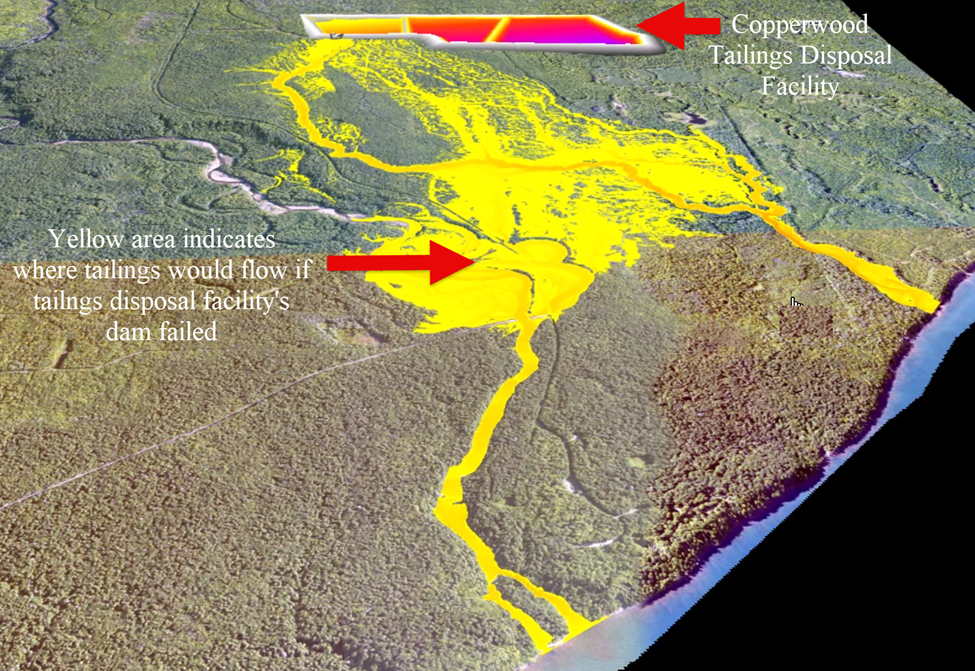
From studies done by Scott Cardiff, John Coleman, and Esteban Chiriboga (Preliminary Dam Breach Inundation Analysis for the Copperwood Project, Administrative Report 24-01, July 2024, Great Lakes Indian Fish and Wildlife Commission).
My last blog featured a tiny company, Highland Copper Company Inc., that plans to construct an earthen basin perched on high ground, three miles from Lake Superior. This basin will hold waste (tailings) from its Copperwood Mine. In the event of a catastrophic failure of the sides or continuous seepage through the bottom and sides of this basin, the tailings contents will be released. Will the contents be acidic and / or toxic?
What information is available about acidity and toxicity of Copperwood Mine tailings?
Scott Dean, representative of the Michigan Department of Environment, Great Lakes, and Energy (EGLE) was reported by MLive on January 3, 2024 as saying, “Studies reviewed by EGLE have validated that the materials extracted and produced at this mine [Copperwood Mine] are not predicted to be acid generating or toxic.”
I reviewed information on the lack of acid-generating character of the Copperwood mine ore in a telephone conversation I had with Mike Foley, Project Manager for Copperwood, in September 2024. He referred me to the fact that a mining company, AMAX, in 1957 sank a 71-meter vertical exploration shaft and advanced 635 meters of exploration drifts, including three small stopes. He said, “The ore recovered from this activity has resided on the surface since 1957 and has not resulted in the production of any generation of acid material.”
Orvana Resources US Corporation which owned the Copperwood project after AMAX and before Highland Copper did a detailed study in 2011 of the ore recovered in 1957 and concluded that the ore would almost certainly not become acid generating.
The origin of the Copperwood deposit came from relatively low-temperature hydrothermal fluids which deposited only the sulfide mineral chalcocite with trace amounts of the sulfide mineral pyrite. Many other sulfide mineral deposits in the Northern Midwest come from the injection of high-temperature igneous intrusions that deposited several sulfide minerals which are more highly reactive than chalcocite and therefore are much more likely to generate acidic waters. Given the origin of the Copperwood deposit it is not surprising that acidic waters are not found associated with the ore that was deposited on the ground by AMAX’s operations.
Toxicity of tailings from the Copperwood Mine
Pursuant to my EGLE Freedom of Information Request (FOIA) request, I have received data on the toxicity of materials that would be produced by the Copperwood Mine. This material consisted of a prediction published in 2012 of the tailing disposal facility (TDF) pond concentrations of thirty elements in the TDF pond that would be present during the time the Copperwood Mine is in operation. The presence of these elements does not necessarily indicate that they will be present in toxic levels in the TDF, but with the 2026 changes for processing ore having been made by Highland Resources for the Copperwood Project it would appear that 2012 data on TDF pond element concentrations would not now be valid.
One obvious element to consider for toxicity is copper. Copper will be recovered from the material mined at the Copperwood Mine by the flotation method. As announced by Highland Copper on October 15, 2025, based on the positive results from the 2025 metallurgical test work program, the process plant has been broadly redesigned with an optimized reagent scheme. The redesigned plan is expected to achieve 87.6% copper recovery. This means that 12.4% of the copper will not be recovered and this copper will be part of the mine tailings that will be placed in the TDF.
Copper is an abundant trace element found in the earth’s crust and is a naturally occurring element that is present in surface waters. It is a micronutrient for both plants and animals at low concentrations and is recognized as essential to all plants and animals. However, it may become toxic to some forms of life at elevated concentrations.
A nuanced response on toxicity
Responding to my question on August 16, 2024, on the toxicity of tailing from the Copperwood Mine Melanie Humphrey, Mining Specialist, Michigan Department of Environment, Great Lakes, and Energy, said that the results of short-termed testing reported in 2011 for representative samples of tailings from the Copperwood Mine indicated that they do not have the “characteristics of toxicity.” She also said that long- term testing (kinetic) [kinetic refers to the rate of chemical reaction or process over an extended period of time] shows that the Copperwood tailings can eventually produce a leachate [water that has percolated through a solid and leached out some of the constituents] at volumes that does not meet water quality standards for release. These tailings under mining rules and water quality standards are determined to be “reactive” and any water that comes into contact with reactive materials is required to be contained and treated for release into the environment. She noted that extensive groundwater and surface water monitoring of the Copperwood TDF is designed to detect any unauthorized release will be required for the Copperwood facility and that at closure of the TDF, as part of the reclamation plan, the facility will be dewatered and capped to prevent the production of high volumes of leachate that would potentially have to be treated in perpetuity.
What do I conclude about acidity and toxicity?
I believe the abundance of evidence indicates that the acidity levels in the tailings from a Copperwood Mine would be low, but there is no current evidence available at this time to determine the toxicity levels of tailings from the Copperwood Mine because the final plans for ore processing and the final design of the TDF have not been determined by Highland Copper. When Highland Copper applies for a new or amended permit for the Copperwood Mine to address their changes to processing ore and TDF design from their original application, they should be required to submit new data like that which was reported of in 2012 for representative samples of tailings from the Copperwood Mine to demonstrate that tailing do not have the “characteristics of toxicity.”
What matters?
Although the characteristics of potential acidity and toxicity of mining the Copperwood deposit can be detailed, the lists of concerns about sulfide mineral mining goes beyond these environmental concerns.
I was reminded of the many distinct concerns for sulfide mineral mining by a response I received on my last blog (March 17, 2026 blog) from Tom Grotewohl, leader of the PTP organization. He said, “One note is that our campaign does not emphasize the issue of acid mine drainage, since it’s unclear to what degree it’s a threat here. Instead we prioritize focusing on other disruptions, such as habitat fragmentation through light, air, noise, and other forms of water contamination; the storage of waste next to Lake Superior and visible from the Park; as well as the perpetual consequences of introducing a power grid and other infrastructure adjacent to a Wilderness area.”
Native Americans’ concerns about sulfide mineral mining also go beyond the environmental issues of acidity and toxicity to what they feel are their spiritual obligations.
On September 14, 2024, members of the Bad River Band and the Menominee tribe accompanied by members of the PTP held a Water Walk from Ironwood, Michigan to the shore of Gichigami (Lake Superior) in the Presque Isle Scenic Area of the Porcupine Mountains. This Walk was a spiritual walk held to pray for water, which Native Americans believe is threatened by the proposal for new sulfide mines in the Lake Superior watershed. These walks have been described as a way Ojibwe women, who have the responsibility to care for the water, fulfill their obligations by singing to the water, making offerings to the water, and making petitions to the water spirits.
My Next Blog
My recommended examination of possible toxicity of tailings of the Copperwood Mine as a necessary part of applying for a new or amended permit for the Copperwood Mine only addresses the local challenges presented by sulfide mineral mining. In my next blog, I will discuss the claims of Native Americans on sulfide mineral mining in the entire area of the Northern Midwest.