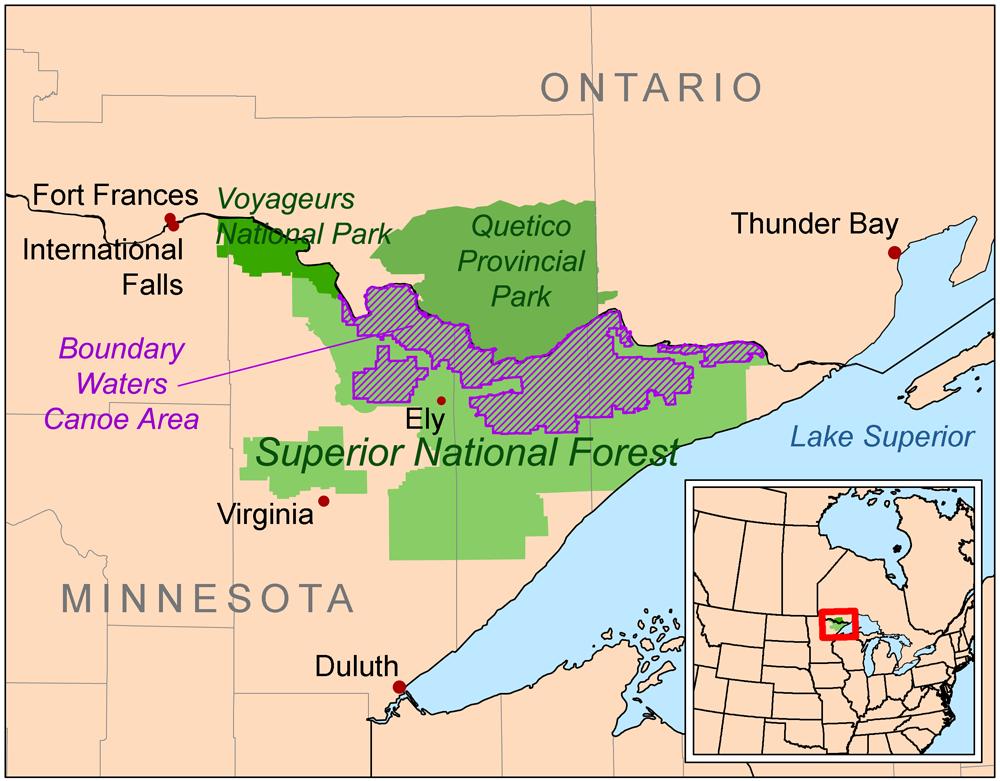
Location of sulfide mineral deposits along the western edge/base of the Duluth Complex. Map is a simplified version of a map published in a report by Mark Severson and Steven Hauck in 2008. They stated indicated resources/reserves tons of ore for each of the deposits were calculated by exploration companies prior to 2008 using different methods and cutoffs. Mining of these deposits will not necessarily recover all of the ore present at a deposit.
The Duluth Complex in northeastern Minnesota hold one of the largest untapped copper-nickel sulfide mineral deposits in the entire world.
On July 29, 2026 the Minnesota Department of Natural Resources (DNR) announced that they had received changes from New Range Copper Nickel LLC to their NorthMet Project, a sulfide mineral mine and processing plant, located in the Duluth Complex southwest of Babbitt, Minnesota. In addition to the recent State of Minnesota filing, New Range filed on July 29, 2026 a Clean Water Act Section 404 wetland permit application to the U.S. Army Corps of Engineers. These filings address previous court and regulatory objections to the NorthMet project. These permit applications are the continuation of efforts that have been made for over twenty years to mine Minnesota’s sulfide mineral deposits.
New Range also announced on July 29, 2026, that they currently hold 21 of the 24 permits required for their NorthMet Operations.
Potential of the NorthMet Project
If approved, the NorthMet Project’s mine would produce 40,000 tons of ore per day for 16 years. It was estimated by the developer of the NorthMet Project in 2019 that 1.2 billion pounds of copper, 170 million pounds of nickel, 6.2 million pounds of cobalt, and a total of 1.6 million ounces of palladium, platinum, and gold would be produced from the NorthMet ore. Also estimated was that the operation of the NorthMet Project would bring approximately 1,000 new jobs to the region.
The NorthMet Project is in an historic mining area, known as the Mesabi Iron Range, and in the vicinity of other past, present, and future mining projects. When it was first proposed over twenty years ago in 2005, it was expected to be Minnesota’s first sulfide mineral mine. The NorthMet project would mine only a portion of the copper-nickel sulfide mineral ore present in one of many copper-nickel deposits located in Minnesota.
Since 2005 the NorthMet project has been relegated to regulatory purgatory. Native Americans and environmental groups have contested the NorthMet Project using the State and Federal regulatory proceedings and the courts. Their objections have been based on plans for tailings storage, financial assurances, potential damage to wild rice, and a host of other issues; it is clear that their opposition is based on their beliefs that they consider any mining of sulfide minerals would be a blot on the landscape.
NorthMet Project’s State of Minnesota’s Permit Approval Problems
The tangled process of receiving the necessary permits necessary for the NorthMet Project started over twenty years ago in 2005. A draft federal Environmental Impact Statement (EIS) was issued by the Minnesota Department of Resources in 2009. The United States Environmental Protection Agency found the 2009 draft EIS unsatisfactory and inadequate. It took until 2013 for the DNR to complete a supplemental EIS (culmination of four years of work by the DNR, U.S. Army Corps of Engineers, and the U.S. Forest Service). It was not until 2016 that the DNR issued a statement that the Final Environmental Impact Statement was considered adequate.
In addition to the EIS requirements, several other permits including dam safety permits for the tailings basin, several waste appropriations permits, public waters work permit, and a permit considering endangered and threatened species were filed in 2016.
In 2018 The DNR issued a draft “Permit to Mine” for NorthMet, but the State of Minnesota’s and the federal application processes for the NorthMet Mine provided environmental groups such as WaterLegacy, Friends of the Boundary Waters Wilderness, Center for Biological Diversity, and the Minnesota Center for Environmental Advocacy, as well as the Fond du Lac Band of Chippewa (Band), to file objections to the NorthMet Project in the Minnesota Courts. The purpose of these objections was to try to obtain contested hearings (and then hopefully as a result of the contested hearings a reversal of a previous approval of the NorthMet Project).
The Minnesota Supreme Court on April 28, 2021, ruled on the issues raised by the opponents of the NorthMet Project. The court said that contested case hearings advocated by the opponents were not required regarding the tailings basin dam, waste storage and seepage containment technologies, alternatives to wet closure, financial assurances, and adequacy of the permit. On only one item did the Supreme Court rule that a contested hearing be held – “whether the ‘bentonite amendment’ as proposed in the permit application, is a ‘practical and workable’ reclamation technique.
A contested ruling opinion issued in November 2023 by Administrative Law Judge James E. LaFave recommended that the Minnesota Department of Natural Resource deny the “permit to Mine” based on his opinion that the plan that had been approved by the DEQ to store tailing waste from the mine “is not practical and workable reclamation technique”.
Following Judge LaFave’s ruling in 2023 the DNR made no attempt to justify their approval of the NorthMet Project in 2016 and 2018, but instead left it up to NewRange Copper Nickel (the current owner of the NorthMet Project) to make a revised proposal.
New Range has said that their new 2026 proposals for the NorthMet Project includes plans to store tailings in existing legacy iron mining pits on recently acquired adjacent lands and replacing rail with an ore conveyor system that will reduce air and dust emissions.
In response to the July 29, 2026 proposals by NewRange for the NorthMet Project, the DNR has said they might determine that a Supplemental Environmental Impact Statement be prepared.
NorthMet’s Federal Clean Water Permit Problems
Although the detailed water quality findings in the 2015 Final Environmental Impact Statement and the issuance of federal Clean Water Permit (CWP) in 2019 approved the NorthMet Project, in June of 2023 the U.S. Army Corps of Engineers (Corps) revoked the NorthMet’s CWP. This revocation came as a result of a 2022 hearing demand by the Fond du Lac Band of Chippewa (Band) where the Band asked that the CWP permit be canceled. The Band basis for asking that the permit be revoked was treaty right obligations, tailing basin failure, environmental justice, and downstream water quality requirements. Although the Corps ruled that treaty obligations, tailings basin dam failure, and environmental justice were not germane to their decision, the reason given by the Corps for the revocation of the permit was the uncertainty of in anticipated drawdown of groundwater and uncertainty in the quantity of total mercury present in the vicinity of the NorthMet Project.
In the Corps’ June 6, 2023, letter detailing the reasons for their cancellation of the CWP for the NorthMet Project they said, “While the Corps is unable to reinstate the permit or modify the permit with new conditions, this decision does not preclude New Range from submitting a new CWA Section 404 permit application that will meet all applicable water quality requirements.
It is interesting to note that the Final Environmental Impact Statement issued in 2015 for the NorthMet Project (worked on from 2005 to 2015) did not find a problem with water quality.
Financial and technical abilities of the operator of the NorthMet Project
Unlike the Copperwood sulfide mineral mine project in Michigan, The NorthMet Project does not lack for the availability of financial and technical resources. The NorthMet Project operates under a joint venture company called NewRange Copper Nickel LLC, which is structured as a 50/50 corporate partnership of Glencore PLC and Tech Resources Limited.
Glencore plc is headquartered in Switzerland and listed on the London Stock Exchange; it operates in more than 30 countries and employs over 150,000 people and produces copper, cobalt, zinc, nickel, lead, and coal. For 2025, Glencore reported adjusted earnings before interest, taxes, depreciation and amortization (EBITDA) were 13.5 US$ billion.
Tech Resources Limited stock is traded on the Toronto Stock Exchange and the New York Stock Exchange. Tech is one of Canada’s largest diversified mining companies and produces copper, zinc, lead, silver, molybdenum, and germanium. For 2025, Glencore reported adjusted earnings before interest, taxes, depreciation and amortization (EBITDA) of 4.3 CAD$ billion.
- When launching the New Range joint venture, Glencore committed an initial $105 million purely to fund early-stage engineering work, baseline infrastructure development, and regulatory restarts.
Conclusion
A Minnesota Department of Natural Resources (DEQ) press release on the changes to the NorthMet Project said that they will determine whether a Supplemental Environmental Impact Statement (SEIS) is required for the NorthMet Project. The DEQ also noted that the proposed changes might require new or amended permits and other approvals from state, federal, and local agencies before it could proceed with construction and operation. The DNR currently says on its website that it will make a determination of the next steps necessary for permitting the NorthMet Project in about a month from when the NorthMet changes were proposed (in other words by the end of August the DNR says they will make a determination).
The chief legal counsel with Water Legacy Council, one of the groups that have opposed the NorthMet Project, told Ben Austin of The Timberjay, “Given the extent of changes [changes to the NorthMet Project announced on July 29, 2026] the new proposal needs to start from scratch.” Starting from scratch would mean that all the applications for the thirty approvals for the NorthMet Project would need to be filed again and go through laborious approval processes which would provide many opportunities for opponents to delay the approval process.
Should Native Americans and environmental groups be successful in requiring a complete new approval process for all of the permits required for the NorthMet Project, the metal production, job creation, and economic activity that will be the result of sulfide mineral mining in Minnesota will become a multi-year process with no certainty that the NorthMet project will ever gain approval.
My next blog will be on the Tamarack Project in Minnesota.
Reference on Minnesota’s extensive sulfide mineral deposits.
Severson, Mark J; Hauck, Steven A. (2008). Finish Logging of Duluth Complex Drill Core. Technical Report NRRI/TR-2008/17. Natural Research Institute, University of Minnesota, Duluth