

Image: Lake of the Clouds in the Porcupine Mountains Wilderness State Park (PMWSP) is located between low ridges of the Porcupine Mountains. Surrounded by virgin wilderness. Lake of the Clouds is the signature feature of the Porcupine Mountains. Just to the south of PMWSP a sulfide mineral mine is about to be dug.
Coming soon to the area where you live or woods and water you treasure could be a new business – mining sulfide minerals containing copper, nickel, and other minerals. This blog is dedicated to the ugly, bad, and good of the business of sulfide mineral mining in the northern Midwest states of Minnesota, Wisconsin, and Michigan. Native Americans, conservationists, and environmentalists have made every effort they can to prevent this. mining. Those who support new mining say that the northern Midwest desperately needs the new jobs and economic activity that would come with the digging of new mines.
Sulfide minerals are different than the historic minerals mined in the upper Midwest
Sulfide mineral deposits are different from the native copper and iron deposits that were mined in the northern Midwest starting in the mid-1800s. Michigan’s historic copper deposits were predominately pure copper. In the historic iron deposits in the northern Midwest, the most common iron minerals are the magnetite, hematite, and specularite which consist of minerals of iron combined with oxygen.
Sulfide minerals contain sulfur combined with metals (copper, nickel, and other metals). If not handled properly, waste from mining sulfide minerals creates acidic water and releases minerals into the environment. Any new mining can bring noise, light, and air pollution into wilderness areas where mining and the milling of ore is taking place.
Although the sulfide mineral deposits in the northern Midwest containing copper, nickel, and other minerals have been known for many years, the White Pine Mine in Michigan in operation from 1955 to 1995, the Flambeau Deposit in Wisconsin which was mined from 1993 to 1997, and Michigan’s Eagle Mine and Eagle East where mining stated in 2014 and continues in operation today are the only three locations of sulfide mineral mines in the Northern Midwest. At the present time work is continuing digging the Copperwood Mine in the Porcupine Mountain area of Michigan’s Upper Peninsula.
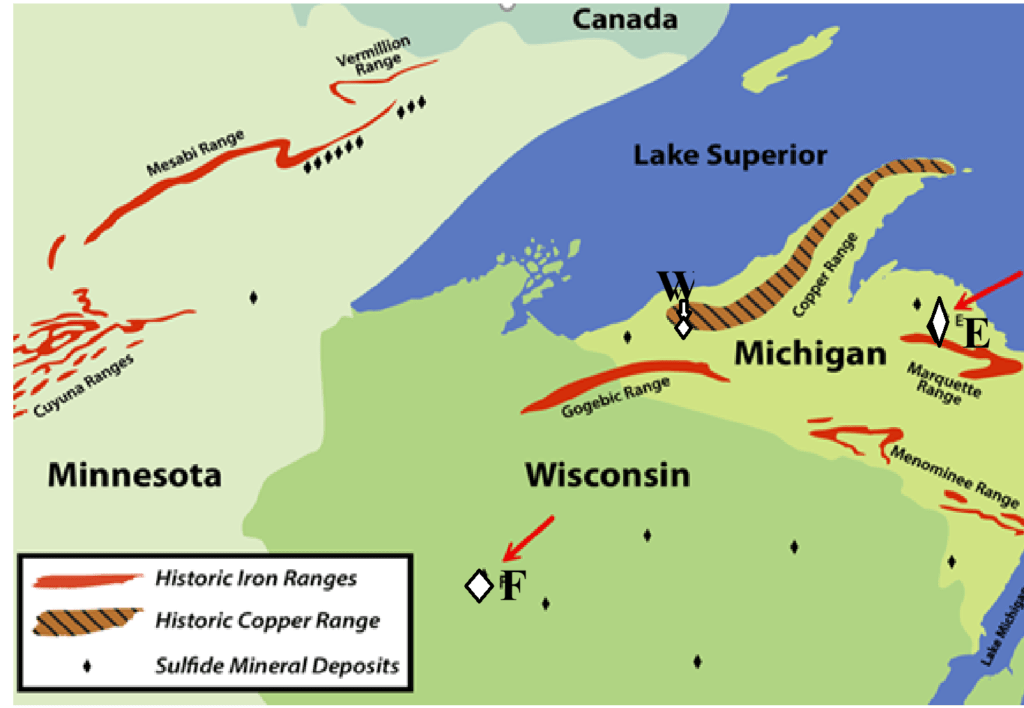
Black diamonds are known sulfide deposits that have not been mined. White diamonds are the three sulfide deposits that have been mined: “F” is the Flambeau Mine, “W” is the White Pine Mine, and “E” is the Eagle Mine”.
The presently known locations for sulfide mineral mining are not the end of the story. Drilling activity is presently planned to define more possible locations where mining of sulfide minerals can be done.
Rising metal prices and demand for metals make new sulfide mineral mines an attractive investment
A January 18, 2026 article by Liubov Georges of S&P Global reported copper prices surged to fresh records levels at the start of 2026. Without significant changes to supply, global copper production is projected to peak at 33 million metric tons in 2030 before declining, while demand is expected to surge 50% from current levels.
The building of data centers and equipment for new fossil-fuel free energy sources is providing increasing demand for the metals that can come from the mining of sulfide minerals. Each new data center that is built requires tens of thousands of metric tons of copper for all the wires, busbars, circuit boards, transformers and other electric components. The demand for copper and nickel is also driven by the demand for transmission lines, wind turbines, electric vehicles, and all the other things necessary for the transition away from fossil fuels.
Recent reporting on sulfide mineral mining
Kaeding, Danielle. “Canadian Mining Company Plans to Expand Drilling in Northern Wisconsin.” Wisconsin Public Radio (Madison, Wisconsin), November 5, 2025. https://www.wpr.org/news/canadian-mining-company-plans-to-expand-drilling-in-northern-wisconsin.
Kraker, Dan. “Twin Metals Seeks to Continue Copper Exploration near Boundary Waters.” MPR News (Duluth, Minnesota), November 17, 2025.
Future blog posts will follow plans for Michigan’s Eagle Mine and Humboldt Mill by the new owner, Talon Metals; the progress of Highland Copper Company to obtain final approval for tailings storage and funding to complete their Copperwood Mine in Michigan; any new actions by the Menominee Indian Tribe of Wisconsin to continue to block the digging of a mine for the Back Forty deposit located on the boundary of Wisconsin and Michigan; and the progress of repealing the moratorium on mining in a watershed neighboring the Boundary Waters Canoe Area Wilderness in Minnesota.
This blog invites comments on the continuing claims for sulfide mineral mines.

One Response
I like the format of this blog.